Dubai: Thoughts and fears upon embarking

I’ve planned to study abroad for as long as I’ve understood what studying abroad was.

I’ve planned to go to North Africa or the Middle East for almost two years.

I’ve hoped I could go to Dubai for over a year.

I’ve known I’d be going to Dubai for a month and a half.

But it didn’t really hit me until I got off the plane in New York what I was really embarking on.

WP_006008
Sunrise on my red-eye from San Francisco to New York City.

I traversed JFK airport in New York City with trepidation, searching for the baggage storage area before I embarked on public transit. I’ve been interning remotely with a literary agency all summer, and decided to take a layover in order to visit them. I clutched a printout of the stops I’d pass and the transfers I needed to make to get there, but felt relatively calm–public transit is a fond friend of mine.

But then I realized that, in less than 36 hours, I’d be travelling similarly in a different country.

In a country where Arabic is the primary language.

In a country where women are more commonly seen than heard.

In a country where no, I couldn’t just take off my jacket and wear a spaghetti-strap dress.

That was when it hit me.

Am I scared? No. I feel intrepid, though I do have a little trepidation.

I don’t know what I’m expecting. But I’m expecting something different, and I’m ready to explore.

WP_006009
The same sun setting over my plane to Saudi Arabia.

on settling down, mortgages.

In our globalizing world, it’s easy to become detached from all the people and all the lives out there. The news reports the numbers of people across the world suffering, and so many stories are designed to tug on our heartstrings that we even detach ourselves from these.

Society dictates a path for a ‘happy’ life. I’ve been told a few times recently that now is the best time in my life to travel. I have no mortgage, no home, no career, no kids, no car. I’ve been told that I’m going to settle down after school and follow this path–getting a job, saving enough to get a mortgage to own a home to have a place to live.

But why must I pick one place?

Cultures are made up by the ways people live their lives influenced by the traditions and stories passed on through generations. I am absolutely fascinated by how someone born in the same time period on the same planet can grow up thinking in an entirely different manner to their counterparts in different cultures.

My favourite genre of literature is generally dystopian because of the worlds that authors can create. Often these worlds are very similar to our own with only a few variables changed, yet these variables cause an entirely different world and way of thinking to create. Yet it amazes me that Western society can be captivated by popular books-turned-movies when they have so many of their own worlds so close.

I believe that living in a place and experiencing its culture leads to not only knowledge of a culture, but true appreciation, and that this appreciation is something that can be shared through stories and experiences. As I have the opportunities to study abroad and travel to unique locations, I feel obligated to share these experiences with those who are unable to do the same.

Everyone’s story is worth being shared, and when people have a human understanding of another culture, they are more likely to be inspired to better the circumstances of the world around them.

As such, I’ll be holding off on that mortgage and on picking that place for a while yet.

Response: Does the ‘female Viagra’ solve an actual problem? An asexual’s thoughts

Recently, the Food and Drug Administration approved Addyi, a prescription drug intended to increase women’s sexual drive, with news articles marketing it as a ‘female Viagra’ and the ‘pink pill.’

I consider myself to be asexual, which, per the Asexuality Visibility and Education Network, means I am “a person who does not experience sexual attraction.”[i] While I’m now comfortable with this identity, I used to question my lack of desire. I never consulted a physician about my disinterest, figuring that I just hadn’t been with the right partners.

Addyi is being marketed as curing hypoactive sexual desire disorder, or HSDD, which is “defined as a deficiency or absence of sexual fantasies and desire, which causes distress or interpersonal difficulty” in the Diagnostic and Statistical Manual of Mental Disorders.[ii] Addyi had been approved “for women whose loss of sexual desire causes marked distress or interpersonal difficulty and is not the result of illness, relationship problems or side effects of other medicines.”[iii]

Strangely, despite all my research on asexuality, I’d never run into this before. The definitions of HSDD and asexuality suggest that rhetoric and semantics might be the only difference. Indeed, the distinguishing factor seems to be the ‘personal distress.’ The definition of HSDD relies on the “assumption that some level of sexual desire is normal.”[iv]

I am asexual, but heteroromantic. As such, I form relationships despite my lack of sexual desire. To date, my lack of interest in sex has caused major issues within two forming relationships. This has most definitely caused me distress, immensely so. Does this mean I am suffering from HSDD? The line is hard to draw.

My issue with Addyi is with its treating a lack of interest in sex as a problem that needs a cure, and in how it might be marketed. Opponents of Addyi are mainly concerned with side effects and risks, concerns that a prescribing physician might address with a patient. A physician might not, however, discuss whether one’s lack of sexual desire is a problem or not, and whether one would be happier with a higher amount of desire.

Sexual dysfunctions in women can be “persistent, recurrent problems with sexual response, desire or orgasm.”[v] Men who typically take Viagra are men with erectile dysfunction –men who experience so-called normal desire but are unable to fulfil this desire due to a physical problem. Viagra targets this, as it “affects blood flow to the genitals.”[vi] However, Addyi is meant to “activate sexual impulses in the brain.”[vii] It tries to fix desire, but ignores other problems women may have with response and orgasm.

Women may have similar issues to erectile dysfunction such as sexual arousal disorder, “the inability to respond normally during sexual arousal, particularly a woman’s inability to generate sufficient lubrication for sex”[viii] or female orgasmic disorder, the “inability to achieve climax during sexual stimulation.”[ix] These are not the problems Addyi is intended to solve. These are the problems sexual health equity advocates need to focus on.

I completely support any decision one might make in regards to their sexuality; however, I implore females ‘suffering’ from HSDD to look into asexuality. Society today is filled with images of sex, and sexual desire is commonly perceived to be natural and encouraged. When I didn’t enjoy sex, not knowing asexuality was a possible orientation, I thought something must have been wrong with me. It is perfectly normal not to experience sexual desire. My biggest concern with Addyi is that it will be pushed on people who have no desire to feel desire or who think something is wrong with them.

[i] The Asexuality Visibility and Education Network. Web. http://www.asexuality.org/home/

[ii] Scutti, Susan. “Asexuality Is Real: How A Rare Orientation Helps Us Understand Human Sexuality.” Medical Daily. 7 May, 2015. Web. http://www.medicaldaily.com/asexuality-real-how-rare-orientation-helps-us-understand-human-sexuality-332346

[iii] Pollack, Andrew. “F.D.A. Approves Addyi, a Libido Pill for Women.” The New York Times, 18 Aug. 2015. Web. 20 Aug. 2015. http://www.nytimes.com/2015/08/19/business/fda-approval-addyi-female-viagra.html

[iv] Scutti, Susan. “Asexuality Is Real: How A Rare Orientation Helps Us Understand Human Sexuality.” Medical Daily. 7 May, 2015. Web. http://www.medicaldaily.com/asexuality-real-how-rare-orientation-helps-us-understand-human-sexuality-332346

[v] “Female Sexual Dysfunction.” Mayo Clinic. 19 Aug, 2015. Web. http://www.mayoclinic.org/diseases-conditions/female-sexual-dysfunction/basics/definition/con-20027721

[vi] Ramsey, Lydia. “That was quick: The maker of the first approved women’s libido drug was just acquired for $1 billion.” Business Insider. 20 Aug, 2015. Web. http://www.businessinsider.com/valeant-acquires-sprout-pharma-for-1-billion-2015-8

[vii] Ramsey, Lydia. “That was quick: The maker of the first approved women’s libido drug was just acquired for $1 billion.” Business Insider. 20 Aug, 2015. Web. http://www.businessinsider.com/valeant-acquires-sprout-pharma-for-1-billion-2015-8

[viii] “Sexual Arousal Disorder.” Psychology Today. 24 Nov, 2015. Web. https://www.psychologytoday.com/conditions/sexual-arousal-disorder

[ix] “Orgasmic Disorder.” Psychology Today. 17 Feb, 2015. Web. https://www.psychologytoday.com/conditions/orgasmic-disorder

on accepting hospitality.

In spending a year abroad, I must continuously remind myself that I have to let people take care of me and be generous to me. I’m going to have to ask for help from strangers.

This is a lot more challenging than it should be. This might be my biggest challenge. (Next to language!)

I spent a week at my parents’ home in San Francisco between my summer in Zion and my semester in Dubai. For a few of those days, an old friend of my dad’s and his wife stayed with us. I’d never met either before; however, I was more than happy to spend a day showing them the sights in San Francisco. Yet when they mentioned having relatives in Dubai I could look up, I instinctively recoiled at the idea of taking advantage of a stranger.

While refusing to accept help is commonly a pride thing, for me it’s an insecurity thing. I don’t want to put anyone out and have them sacrifice time and resources on me when perhaps they don’t enjoy my company or think I’m worth it. I also hate people fussing over me. My automatic instinct is to snap, to refuse help, and to close up.

I detest celebrating my own birthday. If I fall and someone stops to ask if I’m okay, I’ll order them to keep going. If someone offers to drive me somewhere and public transit is possible, I’m taking the public transit. I’m not by nature a generous person–ask anyone who’s tried to have some of my Nutella.

However, I do believe absolutely in offering what help I can–whether it be a makeshift bed on the floor of my dorm room or a secret camping spot in a park. My favourite memory of work at Zion this summer was when I spent fifteen minutes with a customer telling him about all the hikes, and when he returned the next day enthused about the one I recommended.

So intellectually I know that I should have no trouble accepting the same from other people. Emotionally, however, I don’t like to inconvenience people or do something that might put them out.

Instinctively, human nature is to share, and part of sharing is in being shared with. It seems incredibly counter-intuitive to struggle to accept gits, but this year I’ll be working on graciously accepting others’ generosity.

Zion National Park: The Subway in the sun

Unlike the first time I had the opportunity to hike the Left Fork, this time was filled with sun and led to a lot of fun swimming in the pools that make up the Subway.

The lesson of the day: if you are falling, it is better to fall than to grab a cactus. If you grab a cactus, you will promptly let go and fall anyway. If you fall anyway, you will use your hand to attempt to break your fall. If you attempt to break your fall, you will send cactus needles deeper into your hand.

This was a perfect day.
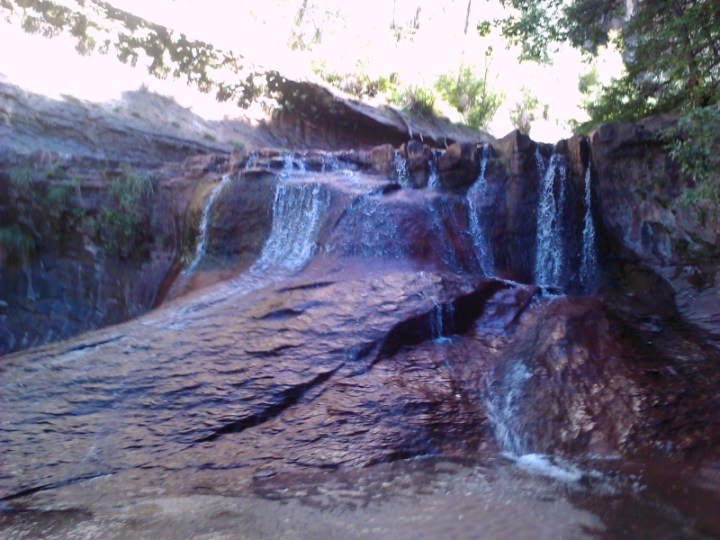
WP_005756 WP_005772 WP_005776 WP_005792 WP_005805 WP_005815 WP_005817 WP_005818 WP_005823 WP_005838 WP_005839 WP_005851 WP_005861 (3) WP_005862

Zion National Park: The Subway in the rain

The Left Fork hike leading to the Subway requires a permit. While generally one needs to participate in a lottery three months ahead of time to obtain one, I was lucky enough to get my hands on one; later in the season, I was able to do the hike again in the sun.
It poured from the second we left the car. At one point, I heard a crash and turned around to find a waterfall had appeared from out of the air. But the Subway itself was absolutely magical.
While it perhaps may have been nicer to explore the waterfall room with its waist-deep icy water in the sun, the rain added an element of mystery to the hike.

Zion National Park: Cable Mountain

Sixteen miles. 2,500 feet. My first weekend in Zion. All me.
“You’re going by yourself?” Well, yeah. There are no bears in Zion. What dangers are there?
About 2.5 miles in, very soon after leaving the well-trodden Observation Point trail, I got lost.
‘This doesn’t feel like the right way, Em,’ I told myself as I held onto a tree, clambering down into a canyon. ‘Are you really sure?’
I frowned as I half-slid, half-fell the last five feet down, scratching one leg on a tree and bruising the other on a rock.
But there were footprints–er, there was a footprint–in the rare sandy patches at the bottom of this canyon, so I decided I must be headed in the right direction. Five minutes of walking later, however, the sides of the canyon had only grown taller, and I was pretty sure I was supposed to be going up.
I backtracked until I came across a sheet of rock that looked scalable.
About twenty minutes of clambering and falling later, I found the trail, and stuck my tongue out at it. I immediately started hiking again–only about thirteen miles to go, right? I’d walked for perhaps another ten minutes when my uneasy feeling began to grow. I was starting to head westward again. ‘Are you sure, Em? If you turn around and then have to turn again, you’re going to feel really dumb. Really really dumb.’ I turned around, making the correct decision. Soon, I hit switchbacks, and almost wished I’d kept going and headed back to the beginning
‘I am never doing this again,’ I thought as I clambered up switchbacks. ‘I don’t know why I would ever want to do this to myself.’
I refused to believe it when the trail finally flattened out again. ‘Nope,’ I told the trail. ‘You’re not fooling me. I’m not getting excited just to have more uphill.’
All around me, insects were chirping. The cicadas obviously thought it was night, and some bugs were out there pretending to be rattlesnakes. Rattle rattle. Hisssss.
To my surprise, the next four or so miles were flat. A lot of the path was sandy, making my feet push to get through each step. The last part was downhill, to my disgust–I knew I’d have to climb up that later.
Around 11:36am, a sign told me Cable Mountain was three miles away. I decided I’d be there by 1pm.
An hour or so later, “Baba O’Reilly” by the Who started playing. I’d been listening to music in alphabetical order and it was the first B song of the day. ‘This will be it,’ I said. ‘This will be the song that takes me to the end.’ Because if that song doesn’t pump you up, what can?
“Out here in the fields…” Daltrey started singing. I walked faster.
All of a sudden, I jumped back. I understood what they meant in the phrase ‘jumped out of his skin.’ There, lying in front of me on the trail, was a snake, at least six feet long and as thick as my arm.
I stood, petrified, for a few seconds, feeling my heart pound. My fear dissipated as I remembered that unless I provoked it, it probably wanted nothing to do with me. Even if it was a rattlesnake. Which it likely was. I snapped a photo of it, and then grew a little bit annoyed. I was supposed to be at the end of the trail. I didn’t want to stop and wait for a snake to cross.
I’d just decided to walk through the underbrush, looping widely around the snake, when it slithered off the path.
Breathing shallowly, I continued along the trail. “Baba” had almost finished when I passed through a clearing and saw the fabled cable works. I had made it!

WP_004977 cable WP_004997 WP_005004 (2) WP_005036

Zion National Park: Angel’s Landing

Though I probably did Angel’s Landing a minimum of once a week this summer, I only went up twice in the daylight. This hike was much more fun to do at night with no people around when it was cool, and made for some incredible stargazing during the new moon and a magical moonlit hike during full moon.

WP_004951 WP_004955

on defining home: emotional

At the age of 20, I had spent approximately 56% of my life in New Zealand, 30% of my life in California, 6% of my life in Maryland, 5% of my life in Canada, and just under 3% of my life in Yellowstone National Park, Wyoming.

They say that ‘home’ is where the heart is. If that’s the case, then my home is Canyon Village in Yellowstone, the place I’ve been happiest. Specifically, the North Rim of the Grand Canyon of the Yellowstone, at 2AM in the morning of a late July night, wrapped in a blanket as it begins to snow.

For me, home was an era. Home was those cool summer nights in ’14 when we drove to Firehole River and swum under the full moon. Home was those late night summer canyon runs in ’13 under glittering stars when I told people more about myself than I’d told anyone in three years.

People fixate on the idea of ‘where are you from?’ because the answer to this question can generally give a sense of who one might be, and with which group they might fit in.

I am a city kid, but I was raised in a town of 40,000 people. I use single quotation marks around most single words, but double quotation marks around speech. I complain that it’s about 40 degrees out (Celsius) or that it’s about ten degrees out (Fahrenheit). I don’t have a glowing beach tan and I don’t listen to Flight of the Concords. I don’t speak like a valley girl and I’ve barely seen half of the Lord of the Rings movies. I am happiest when I am in the middle of nowhere, but I am happiest when anonymous in a bustling city. I could walk to my childhood friends’ homes in less than ten minutes alone, but my best friends live six hour plane rides away. I grow potted plants and support pot plants.

And the 5% of my life I lived in Canada? The biggest memory I have of that era is getting a gameboy advance for Christmas.

Where am I from? New Zealand, California, Maryland, Wyoming? It’s complicated. A nametag stating my birthplace or my permanent residence merely conveys a snapshot of my life, the dust cover of a book that has nothing to do with the inner pages detailing who I am.

Maybe someday I’ll make myself a home. Or maybe home will continue to be with my friends, and with my cherished memories, and I’ll just keep exploring.
see on defining home (clinical.)

Academic: Can you judge a book by its blurb?

This was a paper written December 2014 for my Approaches to Everyday Discourse class.

Can you judge a book by its blurb?

Blurbs defined

How do you decide which book you want to read? When you go into a book store, which books appeal to you enough that you spend your money on them? If you go to a library, which books convince you that they’re worth your time?

Most people have a general idea of what they might want to read for fun. They might like to read romances with happy endings. They may enjoy mysteries that they can solve two pages before the main character does. They might enjoy biographies of people who lived through major parts of history. In a book store or a library, they’ll wander over to the genre they’ve picked out. Once there, they make a selection based on the information they have available. Often times, all the information they will have to decide from will be the dust jacket or front and back covers. If we’re not supposed to judge a book by its cover art, then we are left with only the blurb to help us to make an informed decision about what we’ll read next.

The purpose of this paper is to examine blurbs used for young adult fiction novels and to explore the methods writers of said blurbs employ to capture their audience. Through examining the methods used in a sample of blurbs found on young adult fiction books, we can see the moves that blurbists generally follow typical patterns of moves and employ both pathos and ethos to convince their audiences to read a particular book.

Read more